
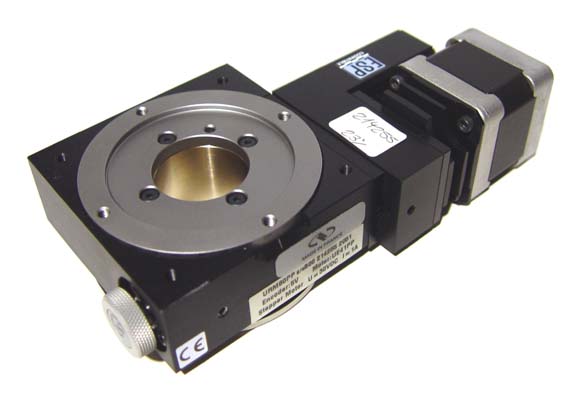
Rotary Stages
Rotary stages are mechanical devices designed to provide precise angular positioning and motion control for various applications. They support high-resolution measurements and positioning with specifications including rotation range, load capacity, and repeatability.
Popular Manufacturers
Common Applications
optics alignment
metrology
semiconductor manufacturing
laser scanning
machine vision
precision assembly
Frequently Asked Questions
What is a rotary stage used for?
Rotary stages are used for precise angular positioning in applications requiring high-resolution motion control, such as optics alignment and metrology.
How is precision achieved in rotary stages?
Precision in rotary stages is achieved through high-quality bearings and precise manufacturing tolerances, which ensure minimal angular deviation and high repeatability.
What specifications should I consider for a rotary stage?
Consider the rotation range, load capacity, repeatability, and sometimes motor compatibility and control options suitable for your application.
Can rotary stages support heavy loads?
Some rotary stages are designed to support heavy loads, but it's important to verify the load capacity specification to ensure compatibility with your requirements.
Log in with your username/email address