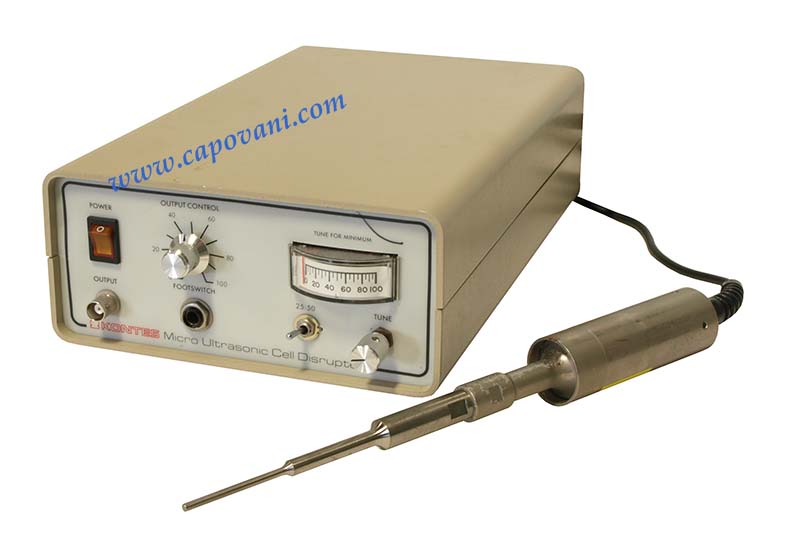
Ultrasonic Disintegrators

Ultrasonic disintegrators are specialized devices that utilize high-frequency ultrasonic waves to break down cells and disrupt complex structures. These instruments support precise control over ultrasonic frequency, typically ranging from 20 kHz to 40 kHz, ensuring accurate and reproducible disintegration processes for laboratory applications.

Common Applications

biological cell disruption

particle dispersion

emulsification

complex molecular breakdown

Buying Guide

Ultrasonic Disintegrators Buying Guide

When selecting an ultrasonic disintegrator, it's essential to consider specific technical requirements to ensure it meets your laboratory needs. These instruments must be capable of providing consistent and reproducible results.

Consider the power settings, as these impact the effectiveness of the disintegration process. Ensure the equipment offers adjustable controls for precise tuning to your specific application.

  • Verify the frequency range, typically between 20 kHz and 40 kHz, for adequate versatility and control.
  • Assess the power output and adjustability, crucial for different processing needs.
  • Consider the unit's compatibility with various sample types for broader application use.
  • Check the instrument's durability and ease of maintenance for long-term efficiency in laboratory settings.

Frequently Asked Questions

What is the typical frequency range for ultrasonic disintegrators?
Ultrasonic disintegrators usually operate within a frequency range of 20 kHz to 40 kHz, allowing precise control of the disintegration process.
How do ultrasonic disintegrators support laboratory applications?
They offer precise cell disruption capabilities, essential for applications requiring accuracy in breaking down biological cells or complex molecular structures.
What factors should be considered when selecting an ultrasonic disintegrator?
Key factors include the frequency range, power rating, and control features to ensure the instrument meets specific laboratory needs.
Can ultrasonic disintegrators be used for non-biological applications?
Yes, they can also be employed for dispersing particles, emulsifying substances, and other applications requiring ultrasonic processing.